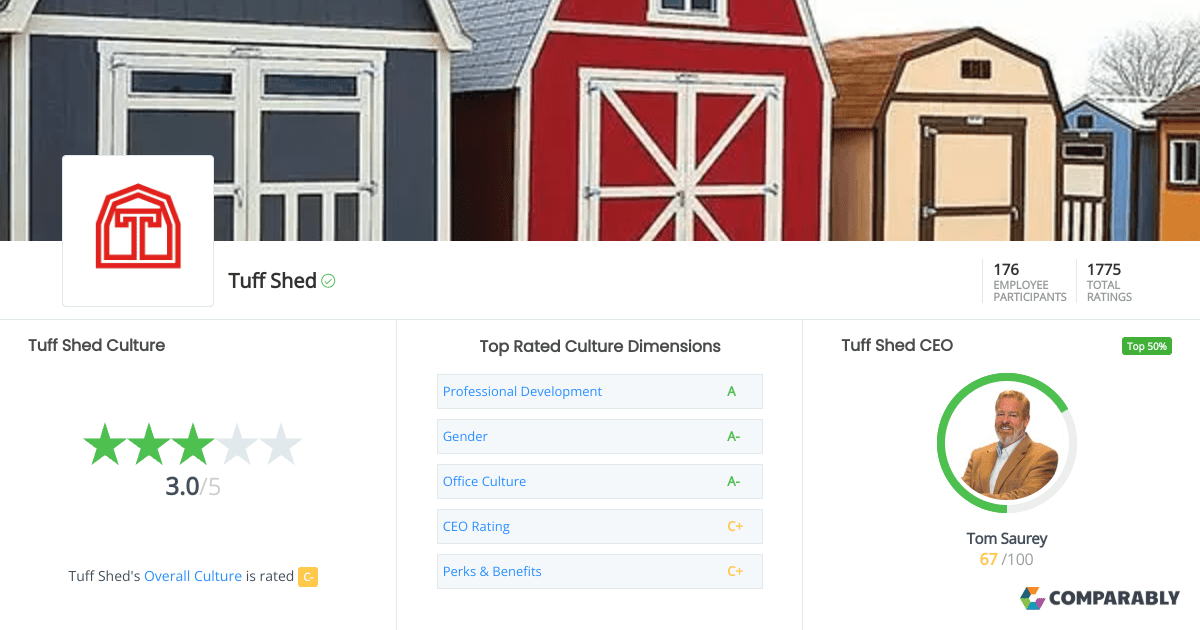
159+ Tuff Shed Headquarters

 www.comparably.com ```html
 Introduction: Building Your Own DIY Storage Shed Ready to tackle a rewarding DIY project and gain some much-needed storage space? Building your own shed can be a satisfying and cost-effective solution. This guide will walk you through the process, step-by-step, from planning to finishing touches. This guide assumes a basic gable roof shed and foundation is a concrete slab. Always check local building codes and obtain necessary permits before starting.
Step 1: Planning and Design Before you pick up a hammer, careful planning is crucial. Determine the size and location of your shed. Consider what you'll be storing and how much space you'll need. Think about setbacks from property lines and any easement restrictions. Create detailed plans. This includes dimensions, materials list, and construction drawings. There are many resources online for free or paid shed plans. SketchUp (free version) is a good option for simple 3D visualization. Obtain necessary permits. Contact your local building department to understand requirements for sheds. This might involve submitting your plans for approval.
Step 2: Foundation Preparation (Concrete Slab) A solid foundation is key to a long-lasting shed. Assuming a concrete slab foundation: Clear the area. Remove all vegetation, topsoil, and debris. Build the form. Create a wooden frame (using 2x4s or 2x6s) to the desired size and shape of your shed foundation. Ensure it is level and square. Compact the base. Add gravel or crushed stone to the form and compact it thoroughly. This helps with drainage and stability. A plate compactor is ideal, but hand tamping will work. Pour the concrete. Order ready-mix concrete or mix it yourself. Pour the concrete into the form, spreading it evenly with a rake or shovel. Level and finish the concrete. Use a screed board to level the concrete surface. Then, use a float and trowel to create a smooth finish. Cure the concrete. Keep the concrete moist for several days to ensure proper curing. Cover it with plastic sheeting or spray it with water regularly.
Step 3: Framing the Walls With the foundation set, you can begin framing the walls. Cut the lumber to the required lengths according to your plans. Use pressure-treated lumber for the bottom plates (the boards that sit directly on the concrete). Assemble the wall frames. Lay out the studs, top plate, and bottom plate on a flat surface. Space the studs 16 inches on center (O.C.) or 24 inches O.C. depending on your plans. Use nails or screws to secure the frame together. Frame openings for doors and windows. Add headers above the openings to support the load. Raise the walls. With the help of a friend or two, carefully lift the wall frames into place on the foundation. Secure the walls. Use screws or nails to attach the wall frames to the foundation and to each other at the corners. Ensure the walls are plumb (perfectly vertical) using a level. Brace the walls temporarily to hold them in place.
Step 4: Installing the Roof The roof protects your shed from the elements. Build the roof trusses or rafters. You can either build your own trusses or rafters based on your plans, or purchase pre-made trusses. Ensure they are properly spaced and securely attached to the top plates of the walls. Install the roof sheathing. Cover the rafters or trusses with plywood or OSB sheathing. Use nails or screws to attach the sheathing to the rafters. Apply roofing felt or underlayment. This provides an extra layer of protection against water damage. Install the roofing material. Choose your roofing material (asphalt shingles, metal roofing, etc.) and install it according to the manufacturer's instructions. Overlap the shingles properly to prevent leaks.
Step 5: Adding Siding and Trim Siding and trim give your shed its finished look and protect the walls. Install the siding. Choose your siding material (wood siding, vinyl siding, metal siding, etc.) and install it according to the manufacturer's instructions. Overlap the siding properly to prevent water penetration. Add trim around doors, windows, and corners. Trim adds a decorative touch and helps to seal gaps and prevent water intrusion.
Step 6: Installing Doors and Windows Access and natural light are important features of a shed. Install the door. Follow the manufacturer's instructions to install the door in the framed opening. Ensure it swings freely and latches securely. Install the windows. Follow the manufacturer's instructions to install the windows in the framed openings. Seal around the windows with caulk to prevent leaks.
Step 7: Interior Finishing (Optional) Depending on your needs, you may want to finish the interior of your shed. Insulate the walls and roof. This can help to regulate the temperature inside the shed. Install interior wall paneling. Plywood, OSB, or drywall can be used to create a finished interior. Add shelving and storage solutions. Maximize your storage space by adding shelves, hooks, and other storage accessories.
Step 8: Final Touches and Cleanup The final steps are important for a polished and safe result. Caulk and seal any gaps or cracks. This will help to prevent water and insect intrusion. Paint or stain the exterior. Protect the siding and trim with paint or stain. Clean up the work area. Remove all debris and construction materials. Landscaping. Consider adding landscaping around your shed to improve its appearance and blend it into your yard.
Conclusion: Enjoy Your New Shed! Congratulations! You've successfully built your own storage shed. Enjoy the extra space and the satisfaction of knowing you created something useful with your own hands. Remember to regularly inspect and maintain your shed to ensure its longevity.
``` Tuff Shed, Inc.
 www.engineeringplans.com
 Tuff Shed, Inc.
 www.modularbuildings.org
 Tuff Shed Culture
www.comparably.com

0 Comments